


Principles of Antiretroviral Therapy
| Core Principles for Selection of the Ideal Antiretroviral Therapy for the Treatment of HIV |
|---|
|
| Key: ARV = antiretroviral |
Introduction
The development of effective antiretroviral therapy (ART) that can both control HIV infection within an individual and prevent HIV transmission sexually and perinatally has been one of the most important therapeutic advances in the history of medicine. From the first licensed antiretroviral (ARV) medication, zidovudine (AZT or ZDV) in 1987 to the present, treatment strategies have evolved from single-drug therapy to highly effective two- and three-drug regimens. With more than 25 currently available agents in 2026, many of which are coformulated, people with HIV can now achieve viral control, taking as little as a single daily tablet (see the Drug Characteristics Tables). Long-acting (LA) injectable ART (cabotegravir plus rilpivirine) can now be given monthly or every other month, and once-weekly oral regimens are on the horizon. This remarkable progress reflects an evolving understanding of the principles of ART. Although ART effectively suppresses HIV replication in plasma, leading to substantial immune reconstitution and recovery, continuous treatment is required to maintain these health benefits, as interruption of therapy will result in viral rebound. Based on these advances, the Panel on Antiretroviral Guidelines for Adults and Adolescents recommends ART for all people with HIV to reduce the morbidity and mortality associated with HIV (AI) and to prevent HIV transmission to sexual partners and infants (AI). ART should be initiated as soon as possible after HIV diagnosis (AII) (see Initiation of Antiretroviral Therapy). These guidelines aim to support prescribers in selecting effective ARV regimens grounded in the principles outlined above and informed by clinical evidence.
Mechanisms of Antiretroviral Drug Activity
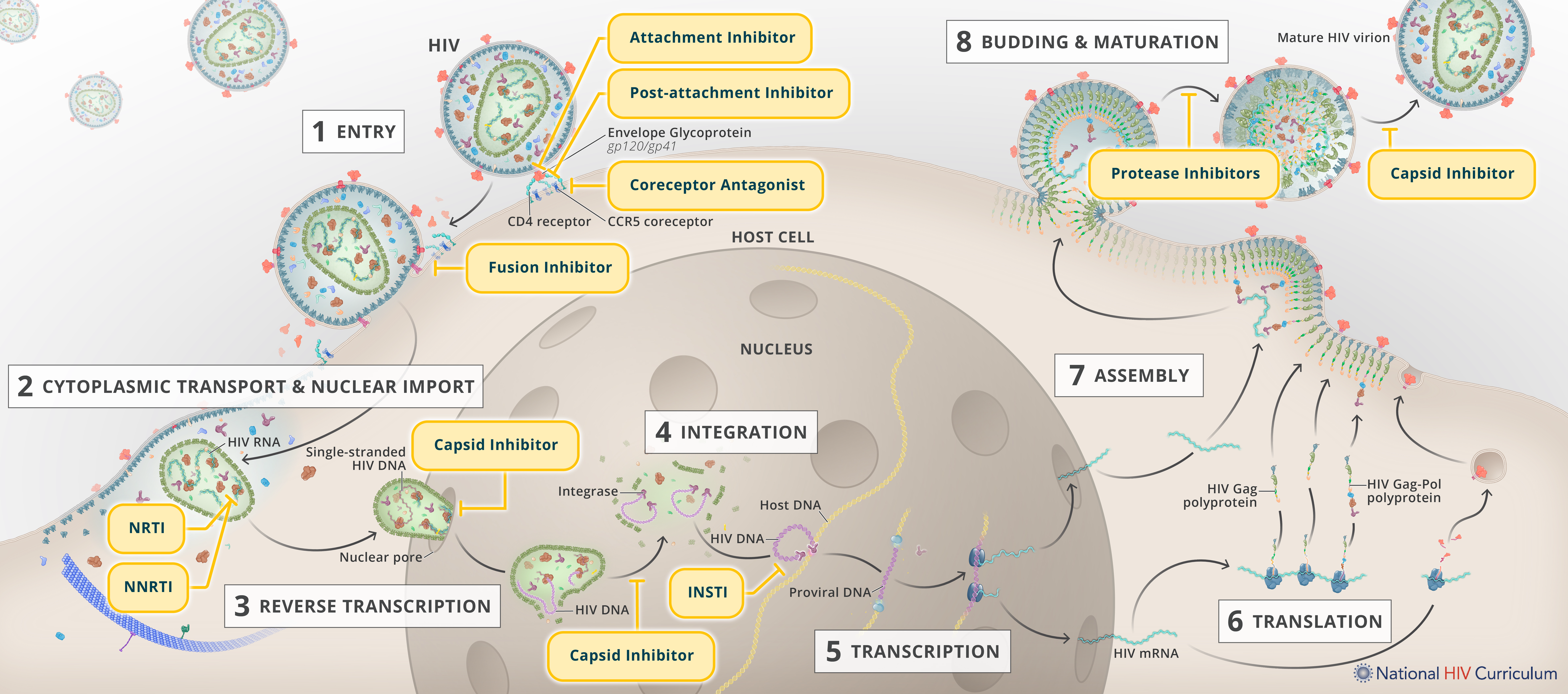
The HIV life cycle is now well characterized, as illustrated in Figure 1 below. Infection of host CD4 T lymphocyte (CD4) cells and subsequent production of infectious virus requires several sequential steps: (1) cell entry, (2) cytoplasmic transport and nuclear import, (3) reverse transcription, (4) integration into the host genome, (5) proviral transcription, (6) translation of viral proteins and glycoproteins, (7) assembly, and (8) budding and maturation. Currently approved ARVs target some of these steps in the HIV life cycle. Entry inhibitors interfere with viral binding to CD4 receptors (attachment and post-attachment inhibitors) or block the chemokine receptor CCR5 (co-receptor antagonist). Nucleos(t)ide reverse transcriptase inhibitors (NRTIs) and non-nucleoside reverse transcriptase inhibitors (NNRTIs) all inhibit reverse transcriptase, the enzyme that converts viral RNA into DNA. Capsid inhibitors act at multiple stages, including preventing transport of the viral capsid containing proviral DNA into the nucleus. Integrase strand transfer inhibitors (INSTIs) block integration of viral DNA into the host genome. Protease inhibitors (PIs) disrupt the processing of viral proteins and glycoproteins, impairing proper assembly of infectious viral particles.
Figure 1. Life Cycle of HIV and Drug Targets for Antiretroviral Drugs
Reproduced with permission from the National HIV Curriculum.
Illustration: Cognition Studio, Inc., and David H. Spach, M.D., University of Washington
Goals of Therapy
Optimal use of ARVs requires understanding the goals of therapy. The primary goal is to suppress plasma viral load (or HIV-1 RNA) to levels below the limit of detection (“undetectable”). HIV-1 RNA levels are measured using real-time polymerase chain reaction assays and reported as copies/mL on both absolute and logarithmic scales. Commercially available assays can quantify levels as low as 20 copies/mL. Virologic failure is defined as the inability to achieve or maintain viral suppression at an HIV RNA level <200 copies/mL. Achieving and maintaining viral suppression dramatically reduces HIV-related morbidity and mortality, including complications of late-stage disease (e.g., opportunistic infections, wasting, AIDS-related malignancies), while also reducing the risk of non-AIDS events (e.g., cardiovascular events) and HIV transmission to others.
History of Antiretroviral Therapy
Viral suppression in plasma was difficult to achieve and maintain early in the treatment era. Initial therapy with AZT or other NRTIs alone or in combination rarely led to full viral suppression and therefore the rapid emergence of drug resistance, with virologic and clinical failure, was inevitable. Similar outcomes occurred when a single active agent was added to existing agents for which drug resistance had already developed. The introduction of new drug classes, particularly PIs in 1995, enabled the adoption of potent three-drug regimens; by enabling consistent viral suppression, these three-drug regimens were associated with dramatically improved outcomes. However, successful outcomes were often limited by intolerance, toxicities, drug–drug interactions, dosing complexity (e.g., large pill burden, multiple daily doses, food requirements), and suboptimal medication adherence. Over time, ARVs became more potent and were associated with less toxicity, fewer drug–drug interactions, and simpler dosing requirements. The latter led to the availability of increasing numbers of fixed-dose combinations (single tablets containing more than one drug) and single-tablet regimens (i.e., a single tablet containing multiple drugs that together make a full ARV regimen). In addition, some new ARVs have longer half-lives, requiring less frequent dosing. Today, durable viral suppression can be achieved with single-tablet regimens, including some two-drug regimens, as well as LA agents.
Core Principles of Regimen Selection
For people with HIV, the best ARV regimen is one that is potent, has a high barrier to resistance, and is both simple to take and well tolerated. These principles are reflected in current treatment guidelines and are discussed individually below.
Potency, Barrier to Resistance, and Durability
The selection of ARV regimens with high potency and high barrier to resistance results in longer durability. Virologic failures are typically driven by insufficient potency of the regimen or insufficient adherence, leading to the emergence of drug resistance (see Virologic Failure).
A highly potent regimen that fully suppresses HIV will decrease the risk of viral replication and the likelihood of development of drug resistance. This principle influences what agents can be used in two- and three-drug combination regimens. Select two-drug regimens with newer agents can be highly effective, whereas older dual-NRTI regimens were unable to achieve viral suppression (see Optimizing Antiretroviral Therapy in the Setting of Viral Suppression and What to Start).
Using ARVs with a high “barrier to resistance” decreases the likelihood that the virus will develop or accumulate mutations that lead to drug resistance. This is an important consideration because the reverse transcriptase enzyme is error prone, leading to frequent mutations, some of which confer a selective advantage in the presence of specific ARVs, reducing drug activity. Resistance mutations can emerge against all classes of ARVs and often confer cross-resistance within the drug class. Over time, newer agents within classes have been developed with resistance profiles that are both distinct from earlier agents and require mutations that are less likely to develop. For example, early NNRTIs (e.g., efavirenz) were broadly compromised by single mutations, whereas newer generations (e.g., doravirine) each have unique resistance profiles. Unlike low-barrier-to-resistance ARVs, for which resistance can develop in weeks, for high-barrier ARVs (e.g., boosted PIs and second-generation INSTIs [i.e., bictegravir, dolutegravir]), resistance mutations infrequently emerge, typically only after ongoing exposure in the setting of persistent viremia.
Individualization and Optimization
Ultimately, the selection of an optimal regimen needs to be individualized to the person with HIV. Factors to consider include prior history of ARV use for treatment or prevention, potential barriers to adherence, comorbidities (e.g., hepatitis B virus [HBV], renal disease), concomitant medications that may result in drug–drug interactions or overlapping toxicities, and patient preferences.
Ideal agents have limited toxicities. Earlier ARV drugs had substantial side effects (e.g., gastrointestinal intolerance, neuropsychiatric symptoms) and toxicities (e.g., neuropathy or lipodystrophy) that impaired quality of life, which led to suboptimal adherence. These side effects are much less common with newer ARVs.
Some comorbidities also influence regimen selection. People with HBV and HIV require concurrent treatment of both HIV and HBV with highly active agents, the latter typically being treated with a regimen that includes tenofovir with or without emtricitabine or lamivudine (or uses entecavir with an active non-tenofovir-containing ARV regimen) (see Hepatitis B Virus/HIV Coinfection). Additional comorbidities may also affect regimen choice, including renal insufficiency, cardiovascular disease, metabolic syndrome, and others (see Adverse Effects of Antiretroviral Medications and the Cardiovascular and Metabolic Complications in People With HIV chapter).
Pregnancy introduces pharmacokinetic considerations (including altered protein binding) and safety considerations for the fetus (see the Perinatal Guidelines).
Drug–drug interactions must also be considered when selecting an ARV regimen, including those involving hepatitis C therapies, antimycobacterial agents, chemotherapy, statins, direct oral anticoagulants, polyvalent cation supplements (e.g., calcium, iron), and acid-reducing agents (see the Liverpool HIV Drug Interaction Checker).
Before choosing a regimen, the prescriber should explore the individual’s barriers and preferences in a nonjudgmental discussion. Understanding a person’s level of pill aversion and/or challenges with pill size, internalized or external stigma, and the presence of safe storage sites may influence regimen choice (see Adherence to the Continuum of Care). Transportation challenges to the clinic and insurance coverage may impact regimen choice. Preferences for injectable versus oral therapy or daily dosing versus less frequent dosing should be considered. Importantly, mental health conditions or active substance use disorders are not contraindications to treatment in a person who is engaged in care (see Substance Use Disorders and HIV). Lastly, costs borne by a person with HIV can be an important barrier to ART initiation and use; incorporating a multidisciplinary approach to link people with HIV to insurance options and additional available services is critical (see Cost Considerations and Antiretroviral Therapy). Ultimately, because of these many challenges, access to continuous, uninterrupted therapy is a privilege afforded to those with stable insurance, housing, and transportation. Without these supports in place, medication interruptions occur. Operational barriers at clinics, such as cost and mental health conditions or substance use, are also key reasons for interrupted care. Clinics should work hard to mitigate these barriers and utilize robust community-based navigation rather than label people with HIV as non-adherent without reviewing their own practices.
Applying the Principles of ART
The principles of ART derived from randomized clinical trials inform all aspects of treatment and apply to options considered for initial therapy, for switching from one suppressive regimen to another, as well as for virologic failure. Treatment in each of these settings is discussed in detail in the following sections: What to Start, Optimizing Antiretroviral Therapy in the Setting of Viral Suppression, and Virologic Failure. Therapeutic options in each scenario are primarily recommended based upon evidence-based efficacy and safety data. Selecting among the options requires individualization based upon special considerations, ranging from regimen dosing and route of administration, adverse effect profile, drug–drug and drug–food interactions, comorbidities, underlying drug resistance, costs borne by the person with HIV, and individual barriers to care and preference. Examples of how these key considerations are incorporated into recommendations for each treatment scenario are summarized below, with details in the respective treatment sections.
- What to Start: The ultimate choice is impacted by a host of factors, including, but not limited to, patient preference, transmitted drug resistance, comorbidities (e.g., chronic HBV, renal disease, and tuberculosis), potential for drug–drug interactions, and exposure to ARVs as part of a pre-exposure prophylaxis regimen.
- Optimizing Antiretroviral Therapy in the Setting of Viral Suppression: In the absence of any underlying resistance to the drugs included in the new regimen, any regimen recommended for treatment-naive individuals is likely to be effective. In addition, if no resistance is present and no evidence of chronic HBV is found, several two-drug regimens are effective. Although switches in therapy can occur in the setting of an underlying drug-resistant virus, such changes need to be made with caution and preferably in consultation with experts in the field.
- Virologic Failure: Despite careful selection, regimen failure can occur. Several factors can contribute to the inability to achieve or loss of viral suppression, including suboptimal adherence, drug resistance, impaired drug absorption, and drug–drug interactions. When adherence challenges are suspected, clinicians should work with the person with HIV to identify underlying barriers and implement strategies to address them, including assessing options to improve access to clinical and supportive services to enhance engagement in care. Regimen switches in the setting of virologic failure (i.e., viral load repeatedly ≥200 copies/mL despite high levels of adherence) should be based on results from cumulative drug resistance testing and will ideally include a fully active high-barrier-to-resistance drug with at least one other active agent, or, if necessary, consideration can be given to using only partially active NRTIs. If a fully active high-barrier drug is not available, the goal is to create a regimen with at least two, and preferably three, fully active agents from other classes.
Overall, the evolution of ART toward potent, well-tolerated, low–pill burden or injectable regimens represents a major scientific achievement, with continued advances anticipated.
| Core Principles for Selection of the Ideal Antiretroviral Therapy for the Treatment of HIV |
|---|
|
| Key: ARV = antiretroviral |
Figure 1. Life Cycle of HIV and Drug Targets for Antiretroviral Drugs
Reproduced with permission from the National HIV Curriculum.
Illustration: Cognition Studio, Inc., and David H. Spach, M.D., University of Washington
Download Guidelines
- Section Only PDF (316.42 KB)
- Full Guidelines PDF (5.06 MB)
- Recommendations Only PDF (297.17 KB)
- Tables Only PDF (1.17 MB)